
Glen Burnie Tree Removal provides arborist services and tree risk assessment in Glen Burnie, MD, serving surrounding cities including Pasadena, Brooklyn Park, Linthicum, Severn and Severna Park. More than 20 years working the same county is what lets us separate a tree that looks alarming from a tree that is actually failing, and the difference between those two is usually several thousand dollars.
An arborist assessment is a different product from a removal quote. A quote prices work you have already decided on; an assessment answers whether the work is necessary, what else the tree needs, and what happens if you wait a season. It is the right first call when a tree has changed — a new lean, a crack, mushrooms at the base — or when a lender, an insurer, an HOA board or a buyer wants something in writing.
Local conditions shape what we look for here. The sandy Patapsco soils common through Glen Burnie are somewhat excessively drained, with an abrupt textural change recorded around 124 centimeters, which gives large trees a wide, shallow root plate rather than a deep anchoring taproot. That single fact changes how much weight we give to soil heave and to a lean that has moved, relative to what the same species would tell us on heavier ground.
What an Arborist Actually Assesses
Root Collar and Root Plate
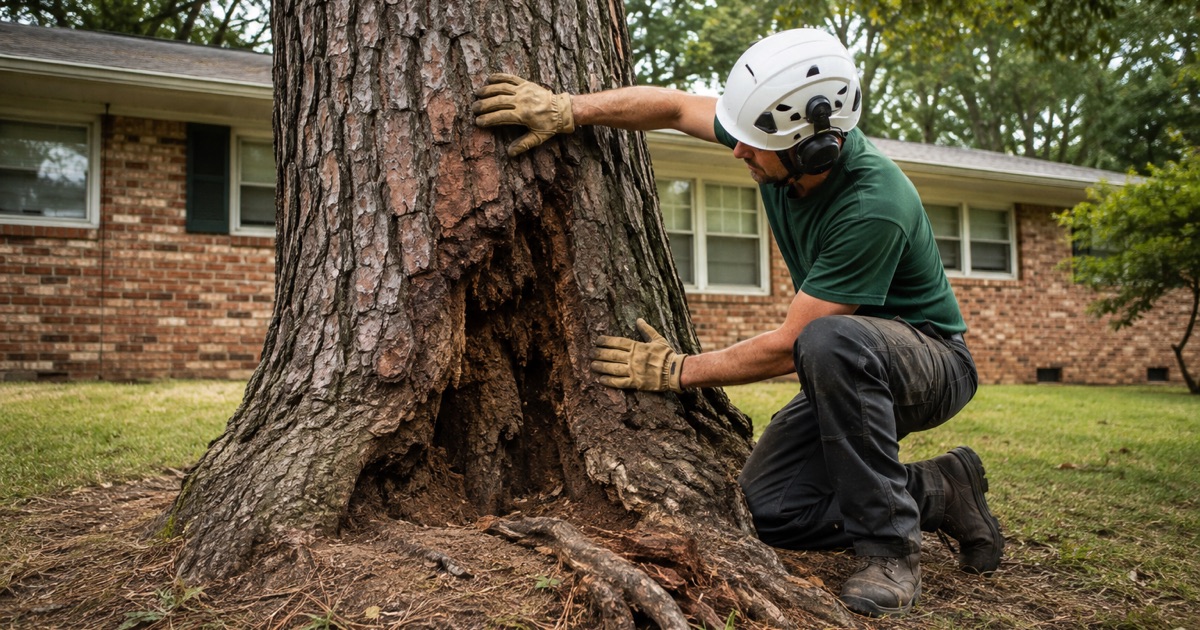
The failures that hurt people usually start below the mulch line. We look for a buried root collar, girdling roots, soil cracking or heaving on the tension side, and any lifting of the plate — and where the flare is buried under grade change or piled mulch, we recommend a root collar excavation with an air spade rather than guessing at what is under there. On shallow-plated coastal plain trees, plate movement outranks almost every canopy symptom.
Trunk and Stem Defects
A stem gets examined for cracks that pass through rather than surface checks, for cavities and the sound wood remaining around them, for conks and fruiting bodies that indicate internal decay, and for old wounds that have failed to close. What matters is not that a defect exists but how much sound wall is left and where the load falls, which is why a hollow trunk is sometimes fine and a small crack in the wrong plane is not.
Crown Architecture and Included Bark
Co-dominant stems that meet in a tight V with included bark are the most common structural failure we see on mature yard trees, because the bark inclusion prevents the two stems from ever knitting together. We map the unions, note which carry included bark, and weigh the lever arm above each one. Epicormic shoots along a limb are a second flag: they usually mean the tree has already lost something.
Species, Pests and What Is Realistic
This is coastal plain species country — loblolly pine is native and common, and northern red oak is documented as rare here, so a large red oak identification is worth confirming before it goes on a report. Emerald ash borer has been in Maryland since 2003 and kills a large ash within roughly three years, so an ash gets assessed on a different clock from everything else on the property.
Tree Risk Assessment, Level by Level
Limited Visual Assessment
The fastest level is a visual pass over a defined group of trees, from the ground and usually from one side, looking for obvious and imminent defects. It is what makes sense across an HOA common area or a multifamily property where the question is which trees deserve a closer look, not what to do about each of them. It is a triage tool and we describe it as one.
Basic Assessment
The basic assessment is the standard product and the one most homeowners want. It is a complete walk-around of the individual tree, ground-based, with the root collar inspected, the trunk sounded, the crown examined from multiple angles and the target — what the tree would hit — identified explicitly. Most reports we write for a single tree are at this level, and most questions are answered by it.
Advanced Assessment
Where a basic assessment cannot settle the question, advanced techniques go further: aerial inspection from a lift, decay detection instruments, or measurement of a lean or a crack over time. This costs more and we recommend it only where the answer would actually change the decision, which is typically a large, valuable, high-target tree the owner would rather keep than remove.
Residential, HOA and Commercial Assessments
Homeowners and Single-Family Lots
On an eighth-acre or quarter-acre lot the targets are close and constant — a bedroom wall, a driveway, a neighbor’s fence line — so the assessment is as much about geometry as about the tree. We tell you what would be struck, how likely it is, and which of the available options actually reduces the risk, including the option of doing nothing this year.
HOA Boards and Multifamily Grounds
Boards and grounds committees need something defensible: a consistent method across a whole property, written findings, and a priority order they can budget against. We schedule around board meeting cycles, inventory the common-area trees in one pass, and hand back a document a board can act on in stages rather than a single alarming number.
Property Managers and Commercial Sites
For managed commercial property the driver is usually documented duty of care and a paper trail that survives a turnover in staff. We provide dated written findings tied to identifiable trees, note which conditions need re-inspection and when, and keep recommendations specific enough that a different contractor could execute them.
Real Estate, Lenders and Disputes
Assessments also get commissioned by a party to a transaction or a disagreement — a buyer, a seller, an insurer, or a neighbor. In those cases we keep the report to observation and professional opinion, state clearly what was and was not inspected, and avoid the conclusions the client would like but the evidence does not support.
Findings, Permits and What Happens Next
The Written Report
Every assessment comes back in writing: the trees identified, the defects observed, the targets, the recommendation and the timeframe. A verbal “that one looks fine” is worth nothing to a board, an adjuster or a court, and it is worth surprisingly little to a homeowner six months later when the tree has changed and nobody can remember what was said.
Critical Area and Permit Findings
The assessment is also where permit exposure surfaces. If the tree sits inside the Chesapeake Bay Critical Area buffer, an approved Vegetation Management Plan is required before anything is cut, dead trees included, and the county has stated that there is no blanket exemption for small stems. Roadside and right-of-way trees run through a separate Roadside Tree Care Permit, and finding that out during the assessment is far cheaper than finding it out mid-job.
Treatment, Mitigation or Removal
A risk finding rarely has only one answer. Reducing the target, pruning out the defective limb, installing cabling and bracing across a weak union, or reducing the crown to shorten the lever arm are all ways to lower risk without losing the tree, and we price the alternatives alongside removal rather than presenting removal as the only route.
- 20+ Years in Anne Arundel
- Free Written Estimates
- 24-Hour Storm Response