
Glen Burnie Tree Removal performs crane-assisted tree removal in Glen Burnie, MD, and after more than 20 years of working small lots in Anne Arundel County we reach for a crane far more often than the trade average would suggest. The reason is geometry rather than size: on an eighth-acre lot with a house, a shed, a fence and a service drop around the tree, there is frequently no honest place for a section to land.
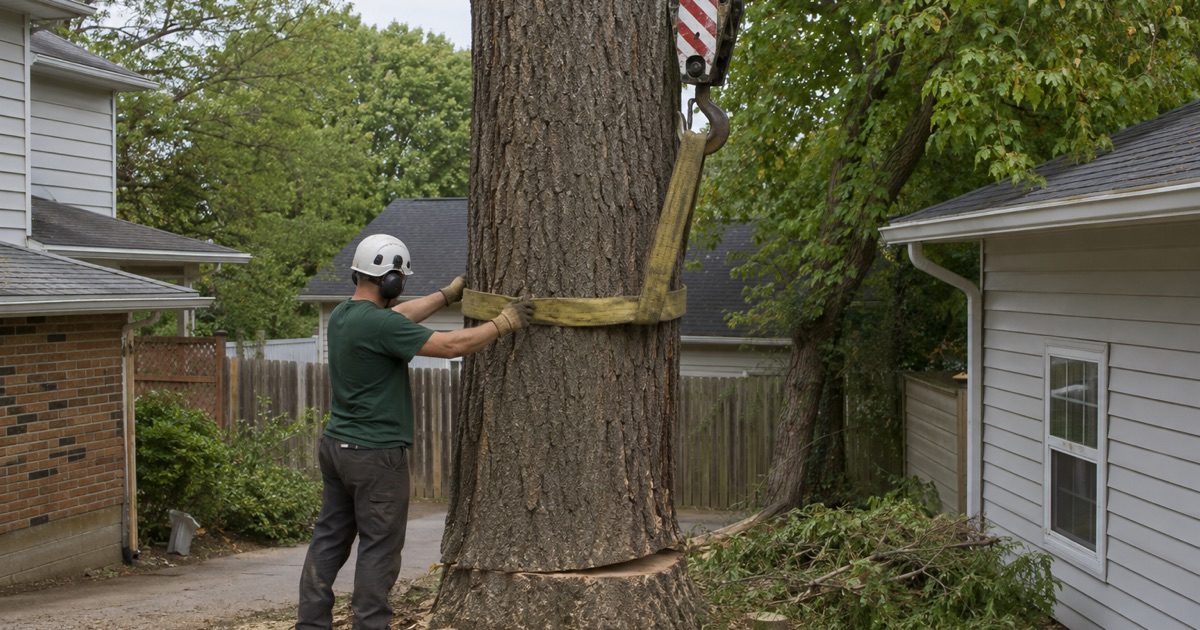
A crane changes the physics of a removal. Instead of lowering pieces on rigging that loads the tree itself and swings the piece across whatever is beneath it, the crane takes the weight of each section before the cut is finished and lifts it vertically out of the canopy. The load never travels over the structure, and the tree is not asked to hold a rigging point it may no longer be sound enough to hold.
That last point is what makes a crane a safety decision rather than a luxury. A standing dead tree, a stem with basal decay, or an ash killed by emerald ash borer — which goes brittle within a few years of dying — cannot be climbed and cannot be trusted as an anchor. On those trees the crane is not the faster option, it is the only responsible one.
When a Crane Is the Right Method
No Honest Drop Zone
The test is simple: is there somewhere a section can land where a rigging failure would cost nothing? Over a roof, a deck, a pool surround, a bulkhead, a septic field or a neighbor’s addition, the answer is no. In that situation we crane the tree out in picks that never pass over the thing being protected, rather than trusting a rope path that only has to fail once.
Dead, Decayed and Brittle Trees
Dead wood breaks rather than bends and will not hold a climber or a rigging load. Ash killed by emerald ash borer is the clearest local case: the borer has been in Maryland since 2003 and kills a large ash within roughly three years, after which the standing wood is brittle. Those trees come out by crane or bucket, never by a climber working the stem.
Trees Over Structures and Utilities
Where a tree stands directly over a house, a garage or a service drop, the crane lets us dismantle it from the top down without any part of the operation crossing the structure. Where a primary conductor is involved the utility comes first and the line has to be de-energized or cleared, and only then does the crane work begin.
Big Trees on Small Lots
The average tree in Glen Burnie stands around 63 feet, and older neighborhoods carry mature canopy on lots too small to fell anything whole. A crane removal on a tight lot is often finished in a single day where a rigged dismantle would take two, and one day of crew time frequently costs less than two days of a larger climbing crew.
Sectional Dismantling as the Alternative
Where a crane genuinely cannot be sited, the fallback is sectional dismantling: a climber or an aerial lift takes the tree down in small pieces, each one lowered on rigging rather than dropped. It is slower, it puts more load through the tree itself, and it needs sound wood to rig from. We will tell you plainly when that method is available and when the condition of the tree rules it out.
Access, Setup and What It Costs
Siting the Crane and Setting Outriggers
The crane has to sit somewhere with firm, level ground and clear overhead space, and that spot is not always the driveway. We assess the setup position during the estimate — ground bearing, outrigger pads, overhead conductors, gate and street width — because a machine that cannot be sited safely is not a method, whatever the tree needs.
Ground Conditions and Protection
Outriggers concentrate an enormous load into four small footprints, which is why pads and matting go down first. Most of Glen Burnie sits on deep, well-draining sand that carries a set-up well, but poorly drained pockets exist inside that otherwise sandy community, and saturated ground under an outrigger is a genuine hazard rather than a lawn-repair problem.
Street, Lane and Neighbor Coordination
A crane setup frequently needs part of a street or a shared lane, and sometimes a neighbor’s driveway to reach over. We arrange that in advance, tell the neighbors what will happen and when, and plan the picks so nothing tracks over a property we do not have permission to be above.
What a Crane Removal Costs
A crane day carries an equipment cost that a rigged removal does not, but it usually buys back crew hours: Baltimore-area crew time runs $210 to $277 per hour, and a job that becomes one day instead of two closes much of the gap. We quote both methods where both are genuinely possible, so you can see the difference rather than being told the crane is necessary.
- 20+ Years in Anne Arundel
- Free Written Estimates
- 24-Hour Storm Response