
Glen Burnie Tree Removal provides emergency tree removal in Glen Burnie, MD, serving surrounding cities including Pasadena, Brooklyn Park, Linthicum, Severn and Severna Park. We answer storm calls around the clock, reach hazard jobs within 24 hours, and will come out the same evening where something is actively unsafe — which after 20 years here is a promise built around how this county’s weather actually behaves.
Anne Arundel’s severe weather record leads with summer convective thunderstorm wind and tornadoes rather than hurricane remnants or nor’easters, and most large BGE outage events trace back to a summer squall line. That means the calls do not trickle in, they arrive in a single afternoon across a whole zone. We staff for that pattern with multiple crews available at once rather than one truck working a list for a week.
An emergency job is also technically different from a scheduled removal, not merely faster. A tree that has already failed is holding stored energy in bent wood, its root plate may still be rotating, and it is frequently resting on something that was not designed to carry it. The sequence of cuts on that tree is not the sequence you would use on the same species standing upright.
What Counts as an Emergency
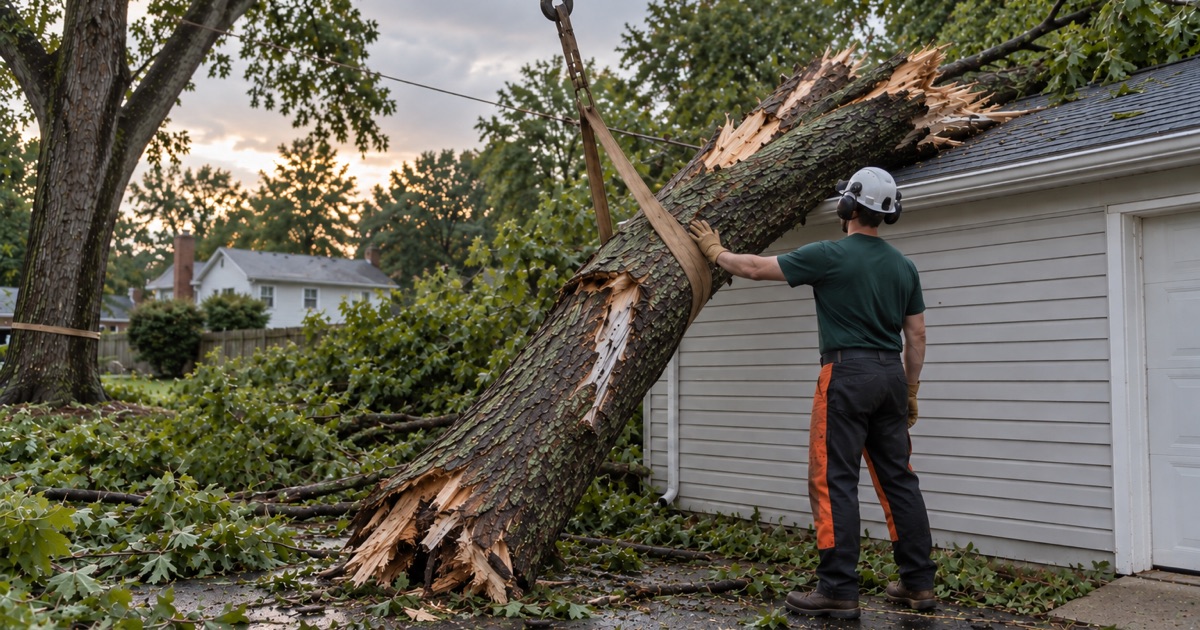
Tree Down on a House, Garage or Roof
A trunk resting on a roof is a load transfer problem before it is a cutting problem. We take the weight off the structure first — by crane or by rigging from an independent anchor — so the roof is not carrying the tree while a saw is running inside it. The remainder comes out in controlled sections, and we can tarp an opening where the deck is breached.
Hanging Limbs and Split Trunks
The hanger is the most common cause of injury on a storm property, because it looks settled and is not. Co-dominant stems with included bark separate at the union under wind load and leave a partly attached limb hanging in the canopy or lodged in a neighboring tree. That gets removed before anything else on the property is discussed, including whether the tree itself stays.
Blocked Driveways, Lanes and Access
Restoring access is a distinct, faster job than removing the whole tree, and we treat it as one. A crew cuts and drags enough of the stem to open the drive or the shared lane in the same visit, then the balance of the removal and the cleanup gets scheduled for a working day. You are not paying emergency rates for the parts that can wait.
Leaning Trees and Lifting Root Plates
A tree that is leaning further than it was, with soil cracking or heaving on the tension side, is mid-failure rather than merely unattractive. The sandy Patapsco soils that dominate Glen Burnie give large trees a wide, shallow root plate rather than a deep taproot, so plate movement here is a more urgent signal than the same lean would be on heavier ground.
Power Lines, Utilities and Who to Call First
A Tree on a Primary Line
Call BGE first, not us. A tree contacting an energized primary conductor is a utility job, and no licensed crew will touch it before the line is de-energized or cleared. Once the utility releases the site we handle what remains — including the wood, because BGE states plainly that it does not remove wood debris after a line clearance cut.
The Service Drop to Your House
The drop running from the pole to your own house is the homeowner’s side of the system and is where most residential line contact actually happens. Where the work needs it, we coordinate a temporary disconnect rather than working a saw within reach of a live conductor. That coordination is part of the job and is arranged before the crew arrives, not from the driveway.
Gas, Water and What Is Under the Root Plate
An upturned root plate lifts whatever was growing through it, and on made ground and fill — common inside Glen Burnie — that can include an old line nobody has a record of. We treat every lifted plate as an unknown until it has been looked at, and any smell of gas ends the conversation until the utility has cleared the site.
Insurance, Cost and Documentation
What Emergency Removal Costs
Emergency work in this area typically runs higher than scheduled removal — a figure near $965 is a common local benchmark against an average removal around $645 — because it is out-of-hours, crew-intensive and technically harder. Baltimore-area crew time runs $210 to $277 per hour. We give you the number before the work, even at two in the morning.
What Your Policy Actually Covers
Most homeowners policies carry a debris removal sublimit around $500 to $1,000 per event rather than per tree, and damage to the tree itself is typically capped near 5 percent of Coverage A. In Maryland, removal is generally payable whether or not the tree struck an insured structure. A tree that lands on a car is normally not a homeowners claim at all — that is comprehensive auto coverage.
Documentation for the Adjuster
We photograph the tree, the failure and the damage before anything moves, and we write the estimate so that emergency stabilization, removal, debris haulage and any structural work read as separate line items. An adjuster can approve a clean itemization quickly; a single lump sum for storm work gets queried, and the query costs you a week.
Neighbor Damage and Liability
Where a healthy tree falls in a storm, the damage is normally the responsibility of the property it lands on. Where the tree was known to be dead or defective and the owner had been put on notice, an insurer may pursue subrogation against that owner. That is precisely why a dated written assessment on a declining tree is worth having before the storm rather than after.
After the Storm
Assessing What Is Left Standing
The tree that came down is rarely the only one that moved. After a squall line we look at what is still standing on the property for fresh cracks, new leans, lifted soil and hangers left high in the canopy, because the second failure usually happens in the next weather rather than in the same event.
Debris, Logs and Cleanup
County curbside collection will not take logs and takes limbs only under 4 feet by 4 inches in bundles under 40 pounds, so storm debris is not something a homeowner finishes over the following weekends. We chip and haul in the same visit unless you want the wood kept, and the written scope says which it is.
Stumps, Craters and Restoring the Ground
A wind-thrown tree leaves an upturned plate and a hole rather than a flat stump. We cut the plate down, grind or excavate what remains, backfill the crater and can seed the ground, so the yard is level again in a season instead of settling unevenly for two years.
Preventing the Next One
Most storm calls we attend were foreseeable — dead wood over a target, an unsupported co-dominant union, a crown carrying more sail area than the root plate can anchor. Deadwooding, crown reduction and cabling ahead of summer cost a fraction of an emergency callout, and we would rather quote that work in April than answer the phone about it in July.
- 20+ Years in Anne Arundel
- Free Written Estimates
- 24-Hour Storm Response