Glen Burnie Tree Removal performs tree trimming and pruning in Glen Burnie, MD, serving surrounding cities including Pasadena, Brooklyn Park, Linthicum, Severn and Severna Park. Over 20 years in Anne Arundel County has taught us that most of what gets called trimming should not be done at all, and that the pruning worth paying for is a small number of correctly placed cuts rather than a large number of convenient ones.
A pruning cut is a wound the tree has to close, so every cut has to earn its place. Good pruning removes what is dead, what is broken, what is rubbing and what is structurally wrong, and it removes clearance where clearance is genuinely needed. Bad pruning removes whatever is easy to reach from where the bucket happened to be parked, and the tree responds with weak epicormic shoots that become the next problem.
The average tree in Glen Burnie stands around 63 feet and is roughly 34 years old, which is the awkward age: big enough that a failure reaches the house, young enough that structural problems are still correctable. That is the window where pruning does the most good per dollar, and it is why we would rather reduce a crown now than remove the tree in eight years.
Types of Pruning We Perform
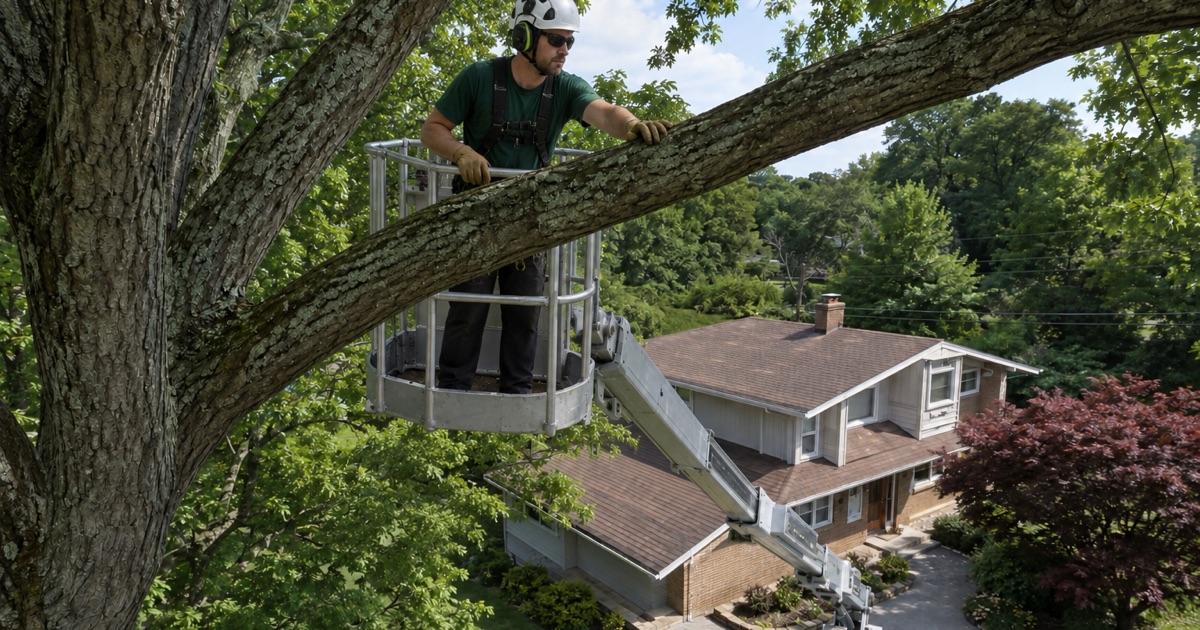
Crown Reduction
Crown reduction shortens leaders and limbs back to appropriate lateral branches, lowering the height, the sail area and the lever arm on a tall stem. It is the right treatment for a tree that has outgrown its position or has a defect it must live with. Done properly the tree keeps its shape; done as topping it does not, and the stubs left by topping decay while sprouting weak replacement growth.
Crown Thinning
Thinning selectively removes a measured proportion of interior branches so wind moves through the canopy rather than pushing it as a solid mass. The discipline is in the dose — taking too much live wood shocks the tree and encourages the same epicormic response as topping. We specify how much comes off and where it comes from, and it is far less than most people expect.
Crown Raising and Clearance Pruning
Raising lifts the lower canopy for clearance over a lawn, a drive or a walkway; clearance pruning cuts a specified distance back from a roof, a chimney, a gutter run or a solar array. Limbs over a roof drop debris into gutters and give squirrels a bridge onto the house, and limbs over a solar array cost production on every clear afternoon. We name the clearance distance in the scope so the result is measurable.
Deadwooding
Deadwooding removes the dead material that is going to come down eventually on its own schedule instead of ours. On a mature oak standing over a driveway, deadwooding alone frequently removes the entire practical hazard without touching a single live branch — which is a much smaller job than the removal the homeowner called about, and we will tell you when that is the case.
Pruning to ANSI A300 — Cuts That Close
Where the Cut Goes
A correct cut sits just outside the branch collar, leaving the collar intact so the tree can compartmentalize the wound and close over it. A flush cut removes the collar and opens a path into the trunk; a stub cut leaves wood the tree cannot seal and cannot supply. Both fail slowly and invisibly, which is why they are still common.
Why We Do Not Top Trees
Topping cuts leaders back to arbitrary stubs with no lateral to take over. The tree responds with dense epicormic shoots that are attached only to the outer wood, so within a decade the regrowth is taller, heavier and far more likely to fail than what was removed. It is also permanent: a topped tree cannot be restored, only managed down.
Dose, Timing and Species
How much live wood can safely come off in one season depends on species, age and condition, and the honest number is usually 15 to 25 percent rather than the half a canopy people picture. Most structural pruning here is best done in the dormant season when the architecture is visible and disease pressure is low, with dead wood removable any time and storm damage handled immediately.
Structure, Support and Young Trees
Structural Pruning for Young Trees
The cheapest tree work anyone buys is a cut made on a small tree. Removing a competing leader, correcting a co-dominant union while the stems are still thin and setting the scaffold spacing early prevents the split that would otherwise take out half the canopy three decades later. A few minutes on a young tree replaces a crane day on a mature one.
Co-Dominant Stems and Included Bark
Where two stems of similar size meet in a tight V, bark often gets trapped in the union and the stems never knit together structurally. Included bark is the single most common failure point we see on mature yard trees here. Where it is caught early the answer is subordination pruning; where it is advanced, the choice is between a support system and removal.
Cabling and Bracing a Split or Weak Union
A cable installed high in the canopy limits how far two stems can move apart under wind load, and a through-rod brace holds the union itself where separation has already started. This supplements sound pruning rather than replacing it, it does not make a failing tree safe, and it needs inspecting on a schedule once installed — all of which we put in writing before it goes in.
Local Conditions That Shape the Work
Storm Pattern and Wind Load
Anne Arundel County’s severe weather record leads with summer convective thunderstorm wind and tornadoes rather than winter events, and most large power outages here trace to a summer squall line. That pattern rewards pruning that reduces sail area and removes hangers before the season, and it is why we schedule reduction work ahead of summer rather than after the first storm.
Coastal Plain Species and Root Plates
This is coastal plain country: loblolly pine is native and common, and northern red oak is documented as rare here, so an identification is worth confirming before a pruning plan is built around it. The sandy Patapsco soils that dominate Glen Burnie give large trees a wide, shallow root plate rather than a deep taproot, which makes crown reduction a more useful lever against wind than it would be on heavier ground.
Utility Clearance and What Is Left Behind
Line clearance around BGE conductors is the utility’s work and is cut to the utility’s clearance specification, not to the shape of your tree. BGE also states plainly that it does not remove wood debris after a line-clearance cut, so the material is left on the property. We handle the balance: hauling what the utility left, and restoring the crown shape on the side of the tree the clearance cut did not touch.
Pruning Inside the Critical Area
Pruning is not automatically exempt from regulation. Inside the Chesapeake Bay Critical Area buffer, Anne Arundel County requires an approved Vegetation Management Plan before vegetation is cut, and the county has stated plainly that there is no blanket exemption for small stems. Roadside and right-of-way trees run through a separate Roadside Tree Care Permit. We check the address before we quote the pruning.
- 20+ Years in Anne Arundel
- Free Written Estimates
- 24-Hour Storm Response