
Glen Burnie Tree Removal handles stump grinding and full stump removal in Glen Burnie, MD, serving surrounding cities including Pasadena, Brooklyn Park, Linthicum, Severn and Severna Park. Twenty years of grinding stumps on this side of the county means we already know what tends to be under them, which is the part of the job that decides whether it takes an hour or a morning.
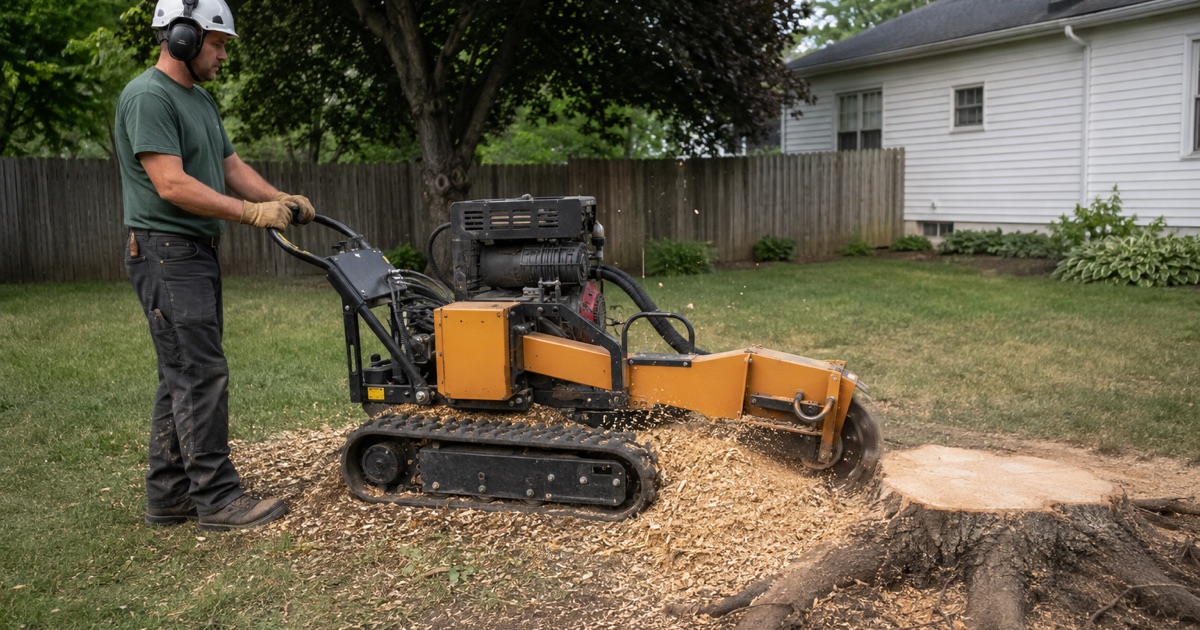
Grinding is a cutting operation, not a digging one. A rotating wheel carrying carbide teeth passes across the stump in horizontal sweeps, reducing the wood and the buttress roots to chips a few inches at a time, working down past grade. Nothing is levered, pulled or excavated, so the surrounding lawn, walls and roots stay where they are.
That matters here more than it does in most places. Small-lot eighth-acre and quarter-acre residential land use dominates Glen Burnie, rear-yard access usually runs through a side gate, and the stump is frequently within a few feet of a fence, a patio or a foundation. Machine width, not engine power, decides whether the job is possible at all, which is why the gate gets measured during the estimate.
How Stump Grinding Works
Grinding Depth and What It Leaves
Standard grinding takes the stump 6 to 12 inches below grade, which is enough to plant grass over and enough that nothing shows through the lawn. Deeper is available and costs more, and it is worth it where sod is being laid, a bed is going in, or something is going to be built across the spot. We agree the depth in writing rather than leaving it to the operator on the day.
Buttress Roots and Grinding Width
The visible stump is only the middle of the work. Buttress roots flare outward at the base and, on a mature tree, run several feet before they drop below grinding depth, so the ground disturbance is always wider than the stump looked. We grind the flares as well as the center, because leaving them is what produces the ridge that a mower finds the following spring.
Access, Gates and Machine Size
We run more than one size of machine for a reason. A compact walk-behind grinder passes through a standard side gate and works in a courtyard a truck-mounted unit cannot reach; a larger machine finishes a big front-yard stump in a fraction of the time. Choosing the smallest machine that will do the job is usually cheaper for the customer than removing a fence panel to fit a bigger one.
Chips, Guards and What the Yard Looks Like After
Grinding produces a surprising volume of chips — a stump generates several times its own apparent bulk once it is cut into fragments. We set guards and mats to keep the chips and any thrown debris off windows, siding, pool surrounds and vehicles, and the written scope says whether the chips are removed, spread as mulch, or left mounded over the hole for you to settle.
Grinding Versus Full Stump Removal
When Grinding Is the Right Call
For almost every residential stump, grinding is the correct answer: it is faster, cheaper, and it leaves the surrounding root system in the ground to decay quietly rather than opening a crater across half a lawn. If the plan for the spot is grass, mulch or a bed, grinding does everything that is needed and nothing that is not.
When the Stump Has to Come Out Whole
Full excavation earns its cost when something structural is going into the same ground: a foundation, a footing, a pool, a retaining wall, or a utility trench. It means a machine, an open hole and imported fill, and it disturbs a much larger area. We quote it separately rather than folding it into a grinding price, so the difference is visible.
Replanting in the Same Spot
Planting a new tree exactly where the old one stood is the request that most often needs more than a standard grind. Ground chips and residual roots tie up nitrogen and hold air pockets, so we grind deeper, pull the chips out and backfill with topsoil where a replant is planned. Offsetting the new tree by a few feet is usually the better answer, and we will say so.
What Is Under the Stump
Fill, Rubble and Buried Utilities
A meaningful share of the ground inside Glen Burnie samples as urban land and loamy Udorthents — made ground and fill. Fill can hide rubble, old foundations and buried utilities directly beneath a stump, and that is a grinding hazard rather than a soil characteristic. Every job goes through Maryland’s Miss Utility one-call service before a wheel turns, and we probe where the history of a lot suggests we should.
Sandy Soils and Wet Pockets
Most of Glen Burnie sits on the Patapsco complex: deep, loose, somewhat excessively drained sand, which is easy going for a grinder. But one in nine sample points across the community falls in the poorly drained Fallsington complex, so wet pockets exist inside an otherwise well-draining town, and they change what can be driven across a lawn. We mat the route in rather than leaving ruts that outlast the stump.
Surface Roots and Lifted Hardscape
The stump is often not the only thing left. Surface roots that lift a walk, crack a driveway edge or catch a mower blade can frequently be ground out along with the stump, and doing both in one visit costs far less than calling us back. Where a root is structural to a tree that is staying, we say so and leave it, because cutting the wrong root is how a healthy tree becomes a removal.
Grinding Near Fences, Walls and Septic
Proximity is the constraint that most often changes the method. A stump hard against a foundation, a retaining wall, a bulkhead or a septic field limits how the wheel can sweep and how close the machine can sit, and on older shoreline lots the drain field is rarely where the owner thinks it is. We work out the approach at the estimate and price the restricted access then, rather than discovering it with the machine already on the trailer.
Cost, Cleanup and Restoring the Lawn
What Stump Grinding Costs in Glen Burnie
Local stump grinding commonly runs about $3 to $7 per inch of diameter, measured across the widest point of the stump at ground level rather than the trunk above it — which is why a quoted figure and a measured figure sometimes differ. Baltimore-area crew time runs $210 to $277 per hour, so a cluster of stumps in one visit is materially cheaper per stump than the same stumps on separate days.
Grinding After Someone Else’s Removal
We grind stumps left behind by other contractors, storms and previous owners, and it is a common call. An old stump is often easier than a fresh one because the wood has softened, though it is also more likely to have settled debris or a rooted-in fence post against it. We quote those from a photograph and a width if getting on site is inconvenient.
Backfill, Topsoil and Seeding
A ground stump leaves a mound of chips that will not grow grass, because the chips lock up nitrogen as they break down. Where you want lawn back, we can haul the chips off, backfill with topsoil and seed, so the spot recovers within a season rather than sitting as a sunken patch of mulch for two years.
- 20+ Years in Anne Arundel
- Free Written Estimates
- 24-Hour Storm Response